


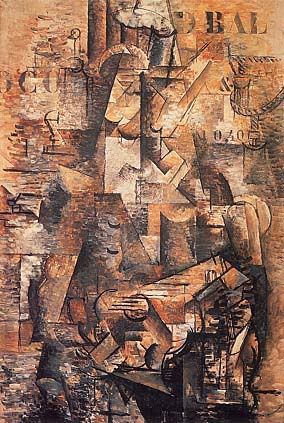
In a search for a different view points I came across some kaleidoscopes in the Science Museum.They were quite fascinating to look through since the distortion pattern of each one was different and even the same images seemed vastly different when seen through them.Again I thought it is a commonly used tool for creating seductive visual forms,not usually associated with type.The segmented structure of the lens reminded me of the eye structure of the insects.This brought me back to my research about the physical process of seeing and I found a really good piece of writing about the similarities between the human eye and the camera.It dealt not only with scientific facts but also had a brief description of the effects of the camera invention on the arts.Allowing us to see things from multiple and new angles,the invention of the camera had significant impact on Cubism and Futurism.In fact,If you have ever spend sufficient time in front of a cubist painting you might have caught yourself trying to figure out the logic behind its segmentation.At least this is what I do each time when faced with these type of pieces.Even though,the Cubist painters explored the process of looking at objects and creating images simultaneously from multiple points of view, they never wanted to deal with text.One of the first cubist painting on which text can benfound is Braque's painting 'The Portuguese' (1911) http://i20.photobucket.com/albums/b230/exuberantfool/theportuguese.jpg where you can see the stencil-like flat signage the top right corner.
Inevitably, this made me wonder why the mobility of the human eye through the camera had made such an impact and the notion of the segmented vision of the insects did not.And why all these events are reflected in fine arts and hardly used in typography? For that reason,I decided to test a couple of different kaleidoscopes.I wanted to see and capture the distortion they created to typefaces and see to what extend legibility can be challenged in that way.This experiment provided me with a wide range of visual samples because even the slightest change of angle or distance created new forms and shapes of the most common typeface that I used - Arial. I wanted to capture the very delicate and stunning play of these patterns so I attached the kaleidoscopic lens to my camera.This allowed me to capture and print on paper an image which probably no one will ever see in the same way as me ( since the same positioning,light and distance have to be achieved)By combining the kaleidoscope and the camera I was able to look at things with the mobility of the human eye and the segmentation of the insects' eye.It was amazing to observe how an abstract and seemingly meaningless image can be transformed in seconds into a solid form which is a part of structured communication system.(which is a bit like the way I see cubist works)

No comments:
Post a Comment